View the diagrams used in this report: Map Core link
The geospatial industry is in constant flux. Every year at CES, new partnerships are unveiled; automakers sign supply agreements for next-generation infotainment systems; and robotaxi services expand into new continents. Names like HERE, TomTom, Mobileye, Mapbox, NavInfo, Zenrin, Baidu, and Naver are already familiar to both the industry and the public. Yet, grasping the full structure of the ecosystem they operate in remains a challenge. How do these enterprises coexist? Who sits at the true center of the industry? And what forces are pulling the market into the future?
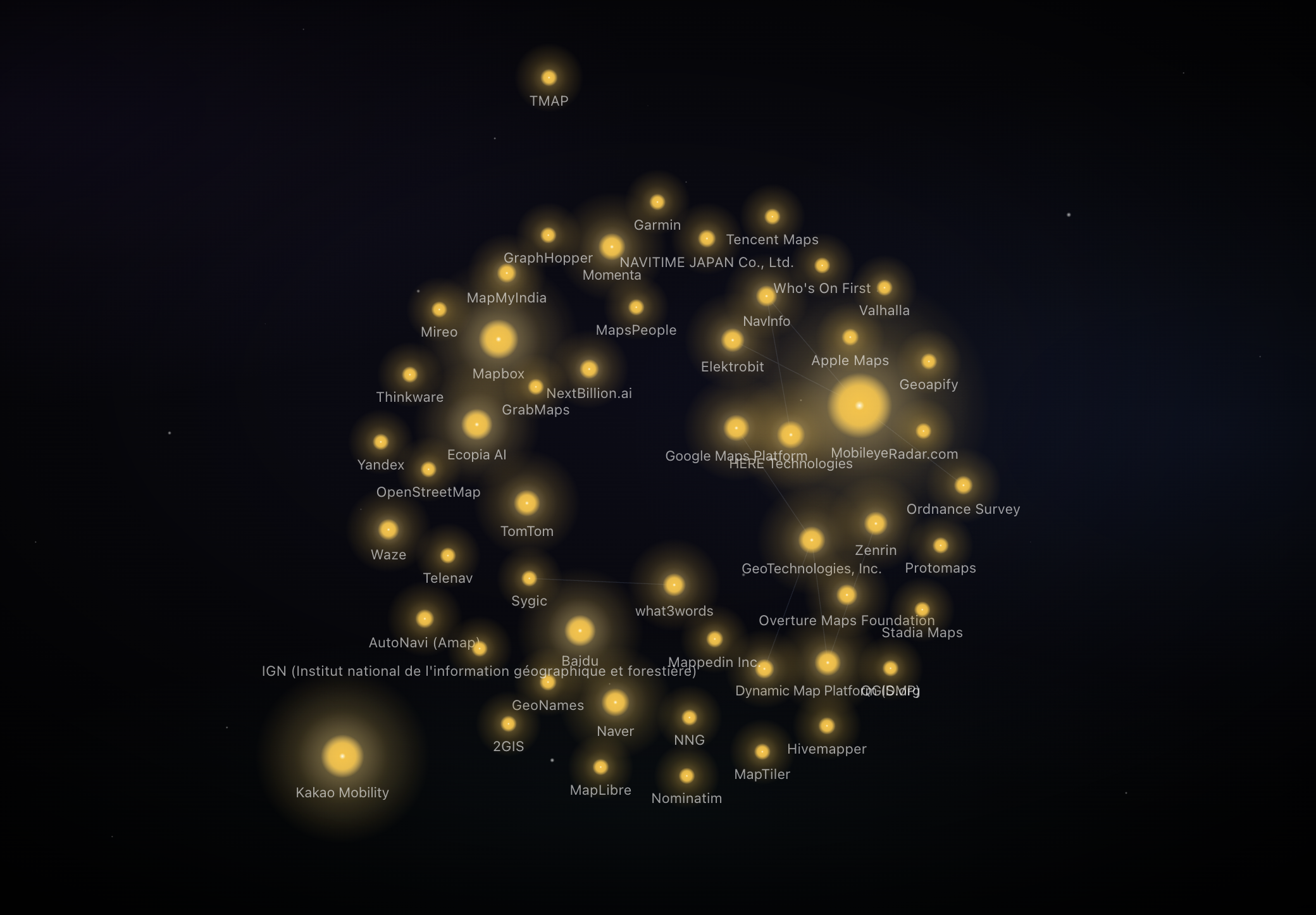
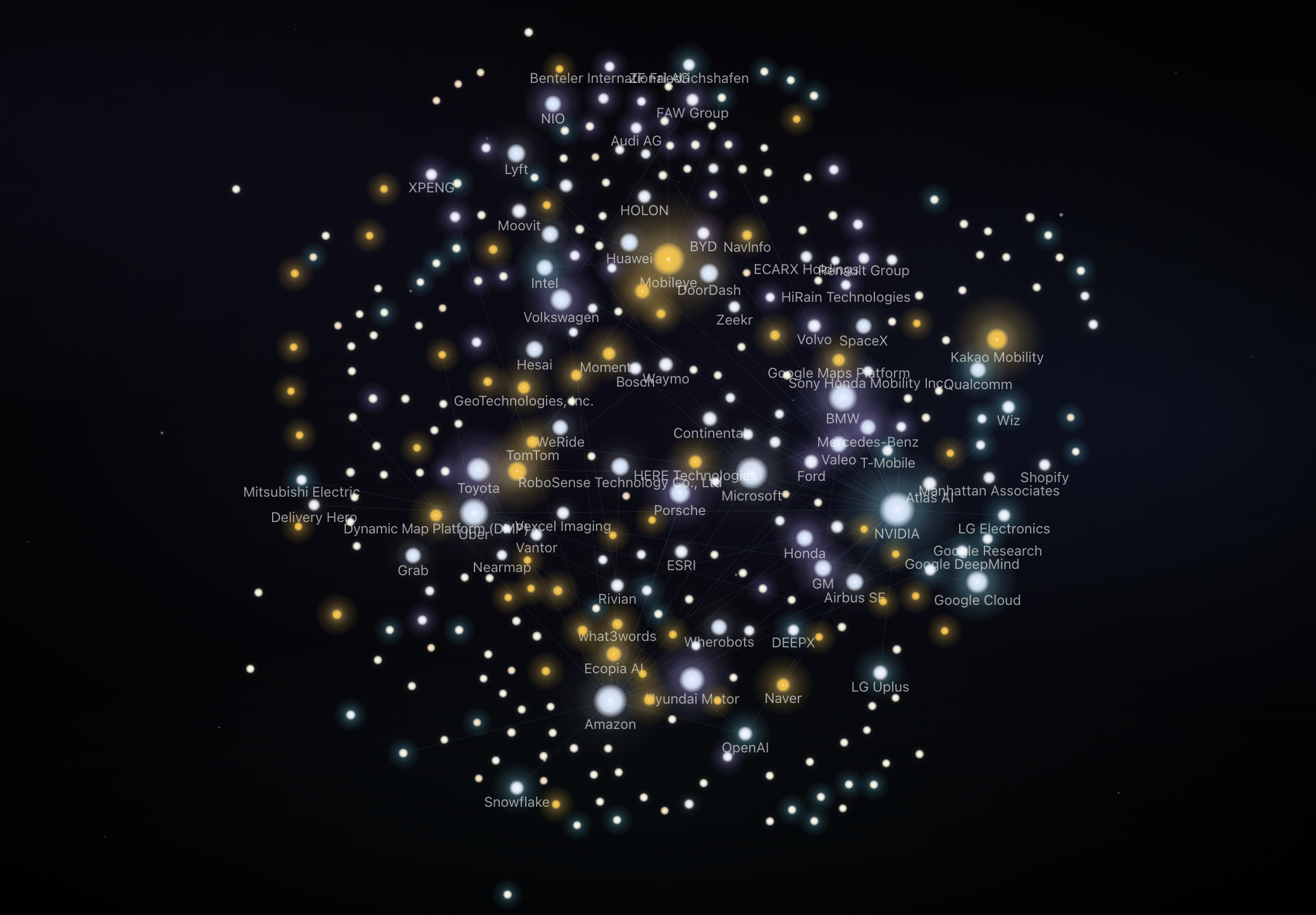
To answer these questions, we mapped out a comprehensive diagram of the geospatial landscape. We visualized the business relationships between 53 core companies—those that turn maps into products—and 315 external enterprises across the broader global economy. In doing so, we transformed a fragmented view of isolated deals into a coherent, birds-eye perspective of the entire industry. This picture reveals two core insights: first, a stable, powerful structure that has defined the market for years; and second, fresh movements actively reshaping it today. In this edition, we focus our analysis squarely on the map industry itself.
Anatomy of the Map Economy
Our analysis begins at the heart of the global map industry with 53 core enterprises. These players span every layer of the map technology stack: from foundational data and high-definition (HD) map providers like HERE, TomTom, NavInfo, Dynamic Map Platform, and Zenrin, to software platforms delivering map services to developers, such as Mapbox, Google Maps Platform, what3words, and NextBillion. It also includes open-source projects providing a free baseline for innovation (OpenStreetMap, MapLibre), alongside integrated giants like Mobileye, Baidu, Naver, and Momenta, where mapmaking and autonomous perception converge. To keep our focus sharp on the finished map products themselves, satellite and surveying firms were excluded from the core group.
Radiating from these 53 core entities, we tracked a total of 493 business relationships. Only 23 of these connections are internal links between mapmakers themselves; the overwhelming majority—470 relationships—stretch outward to 315 external companies in adjacent industries. It is within these outward patterns that the ecosystem's true topology reveals itself. (As a side note, this diagram is a living network, expanding with every freshly captured and verified deal. This report represents a definitive snapshot of the landscape as it stands today.)
Before looking outward, it is worth noting how core mapmakers interact with one another. When it comes to building foundational map geometry, these players routinely choose collaboration over competition. Dynamic Map Platform, which built Japan’s nationwide HD map network, was established in 2016 as a joint venture, with fellow mapmakers Zenrin and GeoTechnologies (then Increment P) joining as founding shareholders. HERE and NavInfo have long maintained a strategic partnership to navigate the complex Chinese market. Meanwhile, TomTom is making major moves by contributing its own road data back to the community-driven OpenStreetMap. The underlying logic is clear: the cost of building and maintaining a base map at a national or global scale is too staggering for any single company to bear. Pooling resources at the baseline, while competing fiercely on the applications and services built on top of it, is simply rational strategy.
Part I: The Structure
Two Massive Poles of Gravity: Mobility and Computing
When we dissect the 470 external relationships, we find they are far from evenly dispersed. Instead, they cluster heavily around two major poles, revealing the commercial forces shaping the industry: the gravitational pull of "Mobility" and "Computing."
The dominant force is undeniably Mobility. The enterprises tasked with moving people and goods through the physical world are the ultimate consumers of map data. The automotive sector alone generates over 100 relationships, forming a dense web that links mapmakers to giants like Toyota, BMW, Ford, Mercedes-Benz, Volkswagen, Geely, and SAIC. Ride-hailing and delivery operators contribute another 79 connections, led by Uber as the single most connected entity in this category, followed closely by Lyft, Moovit, Grab, and Japan's GO. Finally, autonomous driving players (including Waymo, WeRide, Bosch, and Continental) add 30 connections with these mapmakers. Taken together, businesses that transport passengers or freight account for 220 links—nearly half of all external relationships. While maps are often viewed as abstract data infrastructure, the commercial demand funding and shaping this industry stems from the immediate, daily necessity of moving an asset from point A to point B.
The second major driver is Computing, encompassing cloud platforms and AI powerhouses, which command 83 relationships. The dynamics here differ sharply from mobility. Unlike the deep, ubiquitous integration seen in automotive, there is no single, dominant cloud platform monopolizing the network. While Microsoft, Amazon, NVIDIA, Meta, and OpenAI hold vital positions in the web, the kind of exclusivity where "nearly every major map player works with Toyota" does not exist in the cloud domain. Map data remains an essential ingredient for these platforms, yet the industry's true center of gravity rests firmly with the automakers and transport operators, not the cloud tech giants.
Integration Beyond Collaboration
Driven by immense capital, mobility enterprises frequently cross the line from buyers to owners. A defining moment occurred in 2015 when a consortium of German automakers—Audi, BMW, and Daimler—acquired HERE from Nokia, with Volkswagen, Intel Capital, and NTT later joining the investment table. When mapping technology becomes existential to a business, players stop renting the tech and move to own it. A decade later, SAIC Motor’s acquisition of a strategic stake in HD mapmaker Momenta follows the exact same playbook.
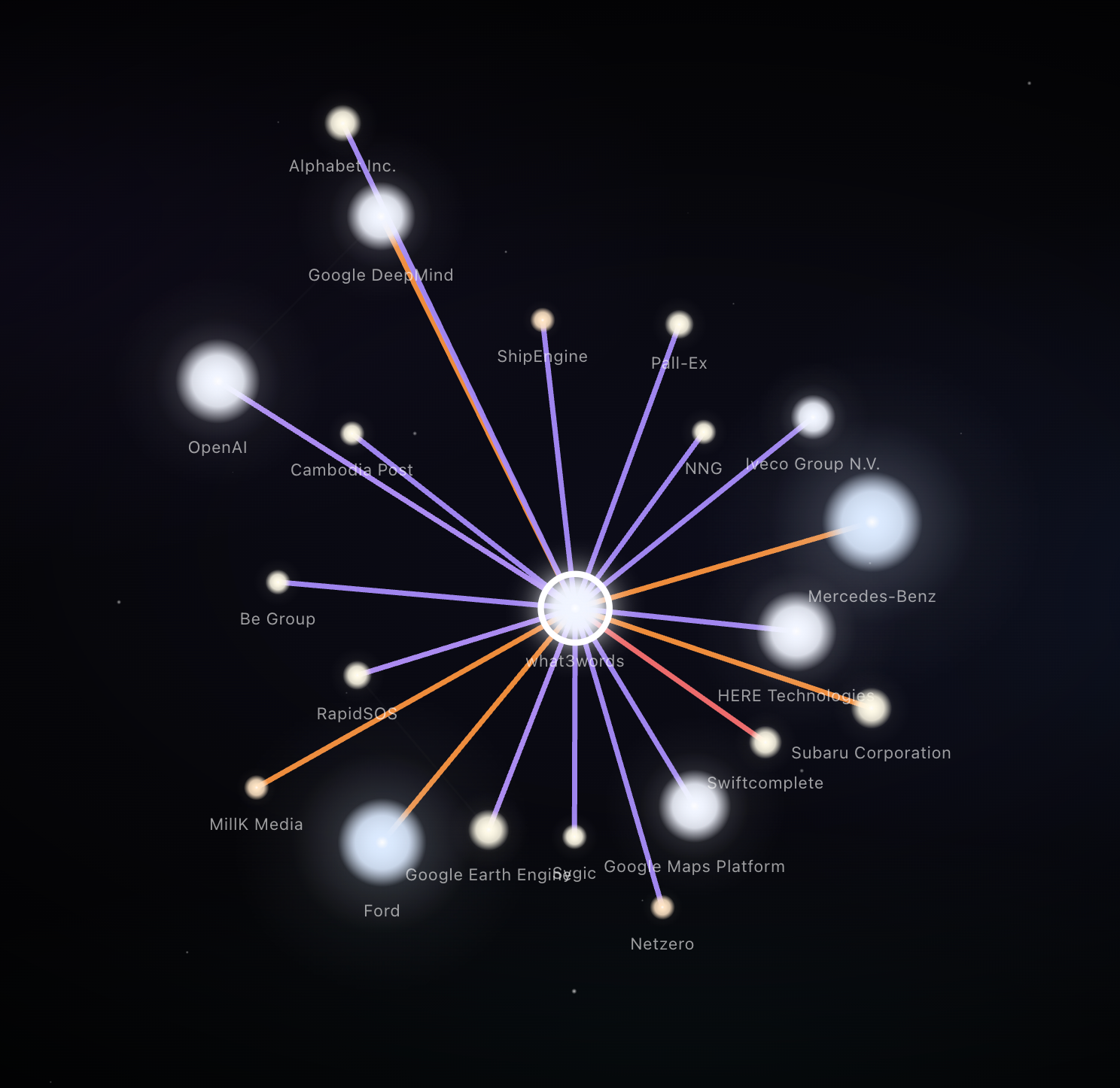
Conversely, map companies are expanding outward to capture adjacent capabilities. Intel-backed Mobileye acquired transit app Moovit; Garmin absorbed race-timing specialist MYLAPS; and what3words bought address-search startup Swiftcomplete. The numbers validate this consolidation trend. Alongside the 259 partnerships and 93 supply agreements in our dataset, we recorded 65 capital-driven transactions—consisting of 30 full acquisitions and 35 strategic investments. The map industry is not merely a passive vendor market; it is actively being reshaped by incoming capital and aggressive internal consolidation.
The Value Chain in Miniature: The Mapbox Stack
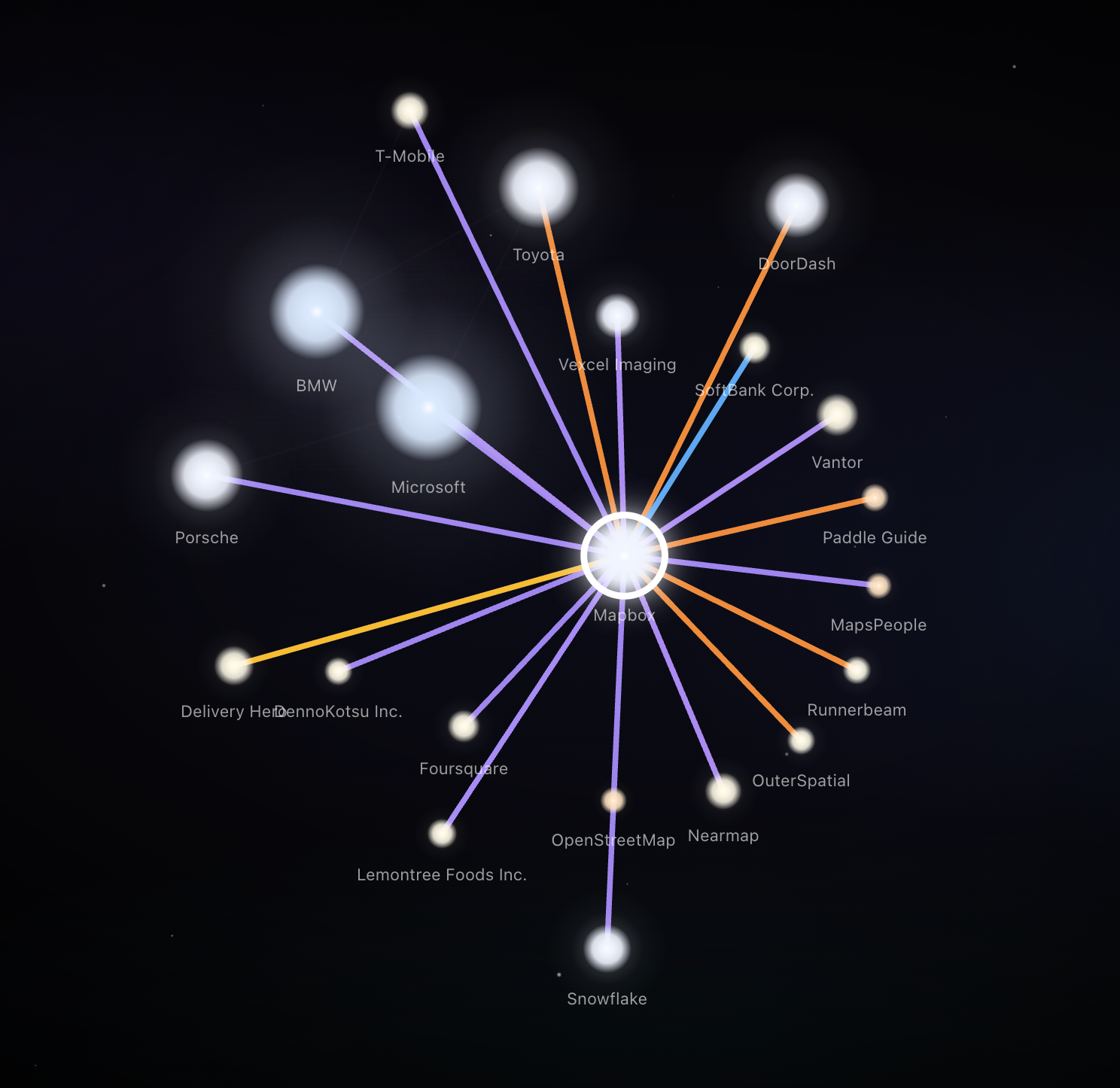
Another dimension of the industry’s architecture is the vertical supply chain running from raw spatial data to final applications. The public footprint of a single company, Mapbox, serves as a textbook miniature of this entire stack.
Mapbox operates as a major buyer of upstream geospatial sources. It sources 30cm satellite imagery from Vantor (formerly Maxar Intelligence), high-resolution aerial imagery from Vexcel, and leverages a data-sharing partnership with cloud data platform Snowflake. At the top of the stack, backed by funding from its joint-venture partner SoftBank, Mapbox packages this data into software products for downstream commercial buyers. It powers the vehicle dashboards of BMW and Toyota, feeds the driver apps of Delivery Hero, and runs regional mobility services like Japan’s taxi dispatch platform DennoKotsu.
Mapbox acts as both a primary consumer of upstream spatial data and a core vendor of downstream software. By tracing a single company’s network through public records, we effectively map the entire value chain—from satellite sensors straight to the driver’s screen.
Part II: The New Dynamics (The Last 18 Months)
Where the Momentum is Shifting
Setting aside long-standing structures to isolate deals struck over the past 18 months reveals where fresh momentum is building. Connecting these recent dots exposes three distinct shifts unfolding across technology, business models, and user access.
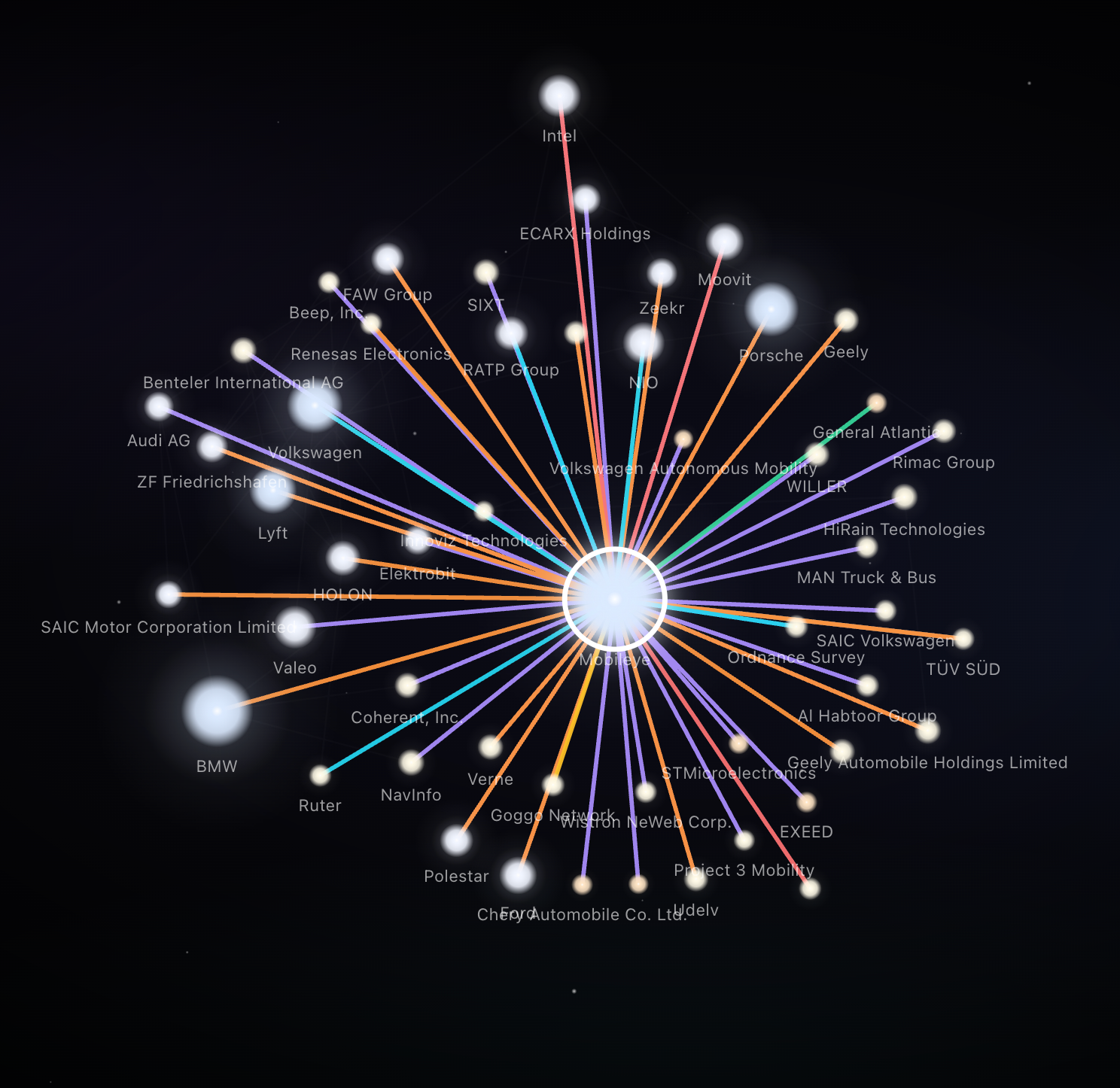
First, autonomous driving is crossing borders, and HD maps are serving as the passport.
When autonomous driving systems expand into new territories, they cannot function without pre-mapped, highly precise local data. Map companies have thus become the critical enablers of international AV scaling. Mobileye, which builds its HD maps by crowdsourcing data from cameras on millions of production vehicles, is now exporting its stack far beyond its traditional hubs. The company secured a pilot deal with Oslo’s transit authority, Ruter, for autonomous ridesharing services slated for March 2026, and is integrating its Mobileye Chauffeur system into the Polestar 4 via Geely’s automotive software arm, ECARX. Similarly, Baidu’s Apollo Go robotaxis—which run on Baidu’s proprietary HD maps—are expanding into Dubai through a partnership with Uber announced in February 2026.
Second, the raw ingredients of mapmaking are fundamentally changing.
For over two decades, maps were built by driving survey vehicles down streets. Today, the methodology is shifting skyward, capturing the world via high-resolution imagery and using AI to automatically extract features. Mapbox aggressively expanded its aerial baseline across 2025 and 2026, adding 10 million square kilometers of 30cm satellite data from Vantor and fresh high-resolution imagery from Vexcel. Ecopia, whose core offering is an AI engine that generates vector maps directly from imagery, partnered with Vantor to build global 3D maps. The playbook is being rewritten: away from ground surveys, and toward aerial AI.
Third, the latest frontier: navigation has started talking.
Our analysis captures a profound shift in the map user interface, moving away from rigid commands toward natural language. At CES 2026, TomTom demonstrated a voice assistant developed with SoundHound, capable of understanding complex, conversational requests—like finding multi-stop routes or locating the nearest EV charging station along a specific path—just as a human passenger would. Days later, collaborating with Visteon, TomTom announced the launch of the world’s first fully on-board infotainment assistant that runs entirely in-vehicle without a cloud connection. This ensures zero latency in tunnels and keeps user destination histories securely offline. Simultaneously, what3words built an assistant using OpenAI models to parse entire conversational sentences and translate them into precise three-word addresses. Though still early, the direction is unmistakable: maps are learning to speak our language.
Formulate Accurate Business Strategies, Faster
This report was built using the analytical engine of APiM Galaxy. Our engine operates on three core principles: first, anchoring all insights strictly to verifiable facts from public sources to ensure reality over speculation; second, translating corporate relationships into quantifiable network models; and third, synthesizing these elements into immediately actionable business strategies.
If your role involves navigating partnerships, investments, or strategy within the map, mobility, or broader geospatial ecosystems, APiM Galaxy delivers immediate operational support. Before your next executive meeting, bypass the 30-minute chatbot grind and access concrete, applicable intelligence. Discover the most efficient paths to target partners through existing networks, or visualize the broader landscape to uncover uncontested market opportunities.
Generate your strategic report on APiM Galaxy: Watch the 2-minute demo
Sources
- German automakers acquire HERE / NavInfo–HERE China JV — Caixin Global — link
- SAIC Motor strategic investment in Momenta — Caixin Global — link
- Garmin acquires MYLAPS — PR Newswire — link
- what3words acquires Swiftcomplete — what3words — link
- Toyota's next-gen navigation built with Mapbox — PR Newswire — link
- Mapbox adds 10M sq km of 30cm satellite imagery (Vantor) — Mapbox — link
- Baidu Apollo Go expands to Dubai via Uber — CnEVPost — link
- Visteon & TomTom launch world's first in-car local AI navigation — PR Newswire — link